


How Long Does a Car Accident Settlement Take in Illinois?
Tue 21 Apr, 2026 / by Robert Parker / Car Accidents
Last Updated: October 24, 2026
Most Illinois car accident settlements resolve in 6 to 18 months from the date of the accident. Cases that go to litigation in Peoria County typically add 12 to 24 months. The biggest variable isn’t the legal process, it’s how long your medical treatment takes to complete.
A straightforward car accident claim with clear liability and completed medical treatment typically settles in 6 to 9 months in Central Illinois. Complex cases, disputed liability, multiple defendants, or ongoing treatment, can take 18 months or longer. Litigation in the Peoria County Circuit Court adds 12 to 24 months to the timeline. Here’s the month-by-month breakdown of what happens and when.
This article provides general information about Illinois car accident claims and is not legal advice. Every case is different. If you have questions about your specific situation, call us at 309-673-0069 for a free consultation.
The Settlement Timeline: Month by Month
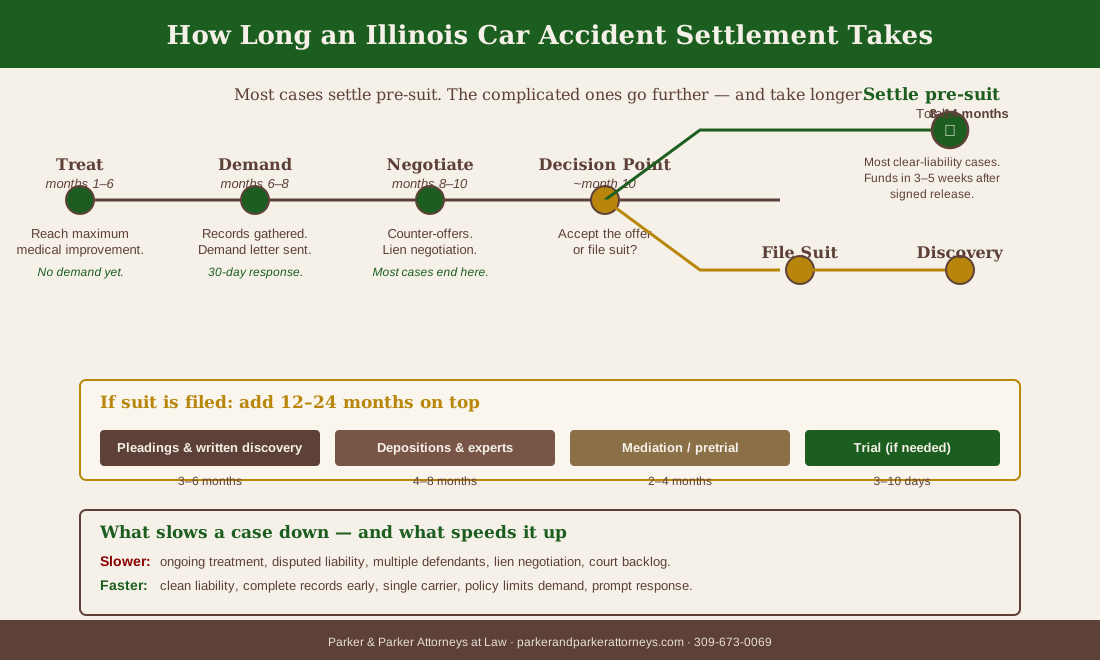
The calendar below reflects typical Peoria County personal injury cases we handle. Your case can move faster or slower depending on injury severity, treatment duration, carrier cooperation, and whether the case needs to be filed.
- Days 1 to 7: Accident documentation and initial treatment. Crash report pulled from the Peoria Police Department, Illinois State Police, or the appropriate investigating agency. Emergency room visit at OSF Saint Francis Medical Center or Carle Health Methodist Hospital (formerly UnityPoint Methodist). Photographs of vehicles, injuries, and the scene.
- Days 7 to 30: Insurance claim opened, adjuster assigned. Preservation letter sent to the at-fault carrier. Representation letter filed. Property damage claim typically resolves in this window on a separate track from the injury claim (vehicle repair 7 to 14 days; total loss 14 to 30 days).
- Months 1 to 6: Medical treatment and records collection. Primary care follow-up. Imaging (MRI typically at the 4 to 6 week mark if symptoms persist). Specialist referrals to orthopedics, neurology, or pain management. Physical therapy. Medical records collected monthly as they accrue. We do not value the case until you reach maximum medical improvement (MMI), the point where further treatment is unlikely to change your condition.
- Months 6 to 9: Demand letter sent, negotiation begins. Once MMI is reached and records are complete, we prepare the demand package: a narrative of liability, complete medical records, billing totals, lost wage documentation, and citations to the applicable Illinois Pattern Jury Instructions (IPI 30.05 pain and suffering, IPI 30.06 medical expenses, IPI 30.04.01 disability and loss of a normal life). 215 ILCS 5/154.6(b) requires the carrier to acknowledge pertinent communications with reasonable promptness, and subsection (o) requires claim forms within 15 working days of a request.
- Months 9 to 12: Settlement or decision to file suit. Most straightforward cases close here. A typical negotiation runs 2 to 4 rounds over 30 to 60 days. If the carrier’s final offer is unreasonable, we decide whether to file suit.
- Months 12 to 24: Litigation (if filed). Written interrogatories are under Illinois Supreme Court Rule 213, including witness and opinion disclosures under Rule 213(f). Document requests are under Rule 214. The litigation timeline also includes depositions of parties and treating physicians and mediation before trial.
- Months 18 to 36: Trial (if settlement fails). Most filed cases still settle during the litigation process, discovery reveals the strength or weakness of each side’s case, and the pressure of an actual trial date usually produces a number. Cases that do go to trial in Peoria County typically take 3 to 5 days before a jury.
What Slows Down a Settlement in Illinois?
- Ongoing medical treatment. The single biggest variable. A case can’t be valued accurately until you reach MMI. Ongoing back pain, headaches, or nerve symptoms at month six means the case doesn’t settle at month six.
- Disputed liability. When fault isn’t clear, intersection accidents, rear-ends with comparative-fault arguments, hit-and-run cases where the other driver disputes responsibility, carriers dig in. Accident reconstruction experts become necessary for I-74, I-474, and complex intersection cases.
- Multiple defendants or multiple injured parties. Each defendant has separate counsel and separate settlement authority. Coordination takes time.
- UM/UIM coverage involvement. If the at-fault driver’s policy limits don’t cover your damages, the claim shifts in part to your own carrier under 215 ILCS 5/143a. That’s essentially a second negotiation with a different adjuster.
- Outstanding medical liens. Hospital liens under the Illinois Hospital Lien Act, ERISA plan reimbursement claims, Medicare or Medicaid recovery, workers’ compensation liens, these get negotiated before the settlement can close. Complex lien work can add 30 to 60 days after a settlement agreement is reached.
- Carrier delay tactics. Some carriers delay deliberately. Progressive has a documented pattern of slow-walking disputed injury claims. Allstate’s “three D” strategy, delay, deny, defend, is built into their standard playbook on disputed cases.
Carrier-Specific Settlement Timelines
The carrier on the other side affects how long the case takes. From our Peoria County case history:
- State Farm (Bloomington headquarters), predictable. First offer within 30 to 45 days of demand. Typical pre-suit resolution 6 to 9 months on straightforward cases.
- Country Financial (also Bloomington), similar to State Farm. Slightly slower on minor-impact defense cases.
- Progressive, aggressive on disputed cases. Pre-suit resolution often 9 to 12 months if they contest injury causation or liability.
- Allstate, often 9 to 15 months pre-suit. Colossus-generated offers require counter-demands with specific IPI citations to move meaningfully.
- GEICO, quick to respond, slow to move. Opening offers within 30 days but negotiation often drags 60 to 90 days longer than other carriers.
- Pekin Insurance, Grinnell Mutual, Shelter, Erie, American Family, Farmers, Auto-Owners, Liberty Mutual, regional and national carriers that generally close cases in 6 to 9 months once liability and damages are clear.
When to File a Lawsuit Instead of Waiting
A personal-injury action is generally filed within two years after the cause accrues under 735 ILCS 5/13-202. For a car crash, that is generally the second anniversary of the crash. In Peoria County, we typically file suit when:
- The carrier has not made a reasonable offer within 60 to 90 days of our demand letter.
- Liability is disputed and the only path forward is discovery.
- The carrier is openly invoking a contested legal defense (e.g., the open-and-obvious doctrine on a shared premises/car crash case) that requires a judge.
- The statute of limitations is approaching and the case isn’t ready to settle.
Filing shifts the case to defense counsel, who typically have wider settlement authority than pre-suit adjusters. The mere fact of a lawsuit filing often produces a counteroffer that didn’t exist at the pre-suit stage.
How to Speed Up Your Settlement
- Be consistent with medical care. Gaps in treatment are the single biggest cause of undervalued settlements. Follow through with every recommended visit.
- Document lost income thoroughly. Pay stubs, W-2s, employer verification letters, tax returns for the self-employed. Incomplete wage documentation is the second most common reason demands get discounted.
- Stay off social media. A photograph of you at a family event during treatment becomes the defense exhibit. Go dark on public accounts during the claim.
- Be realistic about timing. A soft-tissue case with completed treatment can settle in 6 months. A disc-injury case with surgery takes 12+ months to value properly. Trying to settle before you’ve reached MMI almost always leaves money on the table.
- Hire counsel early. Represented claimants typically settle for 2 to 3 times what unrepresented claimants receive, and the negotiation moves faster because the carrier understands the file has real representation.
After You Sign: How Long to Get the Check
Once a settlement is reached and you sign the release, funds flow into our IOLTA trust account. Settlement check processing typically takes 10 to 14 days to clear. We prepare a settlement distribution statement showing every deduction, attorney fees, case costs, medical liens, and then wire or cut the net check to you. More detail on this phase is at our post on how long it takes to get your settlement check after signing the release.
Frequently Asked Questions
Why does it take so long to settle a car accident case?
The biggest reason is medical treatment. Until you reach maximum medical improvement, future medical needs can’t be accurately valued, and settling early risks leaving money on the table for treatment you end up needing later. Most of the “waiting” in a car accident claim is waiting for the medical picture to stabilize, not legal paperwork.
What’s the fastest a settlement can happen in Illinois?
Property damage can resolve in 7 to 14 days. A minor-injury case with completed ER care and no follow-up can settle in 60 to 90 days. But those are outliers. Real injury cases with any meaningful treatment take at minimum 4 to 6 months to reach MMI and another 2 to 3 months for negotiation.
Can I get a partial settlement while waiting for medical treatment?
Sometimes yes. Property damage almost always resolves separately and promptly. Medical payments (MedPay) coverage under your own auto policy can reimburse medical bills up to the policy limit while the main claim is pending. The bodily injury claim itself, however, should not settle in pieces, that releases the claim once and for all.
What’s the two-year statute of limitations and when does it start?
A personal-injury action is generally filed within two years after the cause accrues under 735 ILCS 5/13-202. For a car crash, that is generally the day of the crash. A person under 18 when a cause under sections 13-201 through 13-210 accrues may bring it within two years after turning 18 under 735 ILCS 5/13-211(a). Wrongful death is generally filed within two years after the death under 740 ILCS 180/2, with a longer period for some homicides and for a beneficiary who was under 18.
Should I take the first settlement offer to end it faster?
Almost never. First offers across every major carrier we deal with, State Farm, Allstate, Progressive, Country Financial, GEICO, run 30 to 50% below what the case is worth. The faster you accept, the less you recover. The offer after your attorney’s first counter-demand is usually 40 to 80% higher than the first number the adjuster floated.
What if the insurance company won’t respond?
215 ILCS 5/154.6(b) requires acknowledgment of pertinent communications with reasonable promptness, and subsection (o) requires claim forms within 15 working days of a request. In an action on the policy, a vexatious and unreasonable delay can support attorney fees, other costs, and an added amount under 215 ILCS 5/155. Most of the time, the threat of filing suit in Peoria County Circuit Court is what moves the case.
Trying to Understand Your Timeline? Let’s Talk.
Free consultation. No fee unless we recover. Call 309-673-0069 or schedule online.
Related Articles
- Illinois PI Statute of Limitations
- Can I Sue the Bar or the Party Host After a Drunk Driving Crash in Illinois?
- How Is Pain and Suffering Calculated in Illinois? (2026)
- Can Your Insurer Deny a Claim Over an Unlisted Household Driver in Illinois? (2026 Guide)
- What Happens If You Refuse Medical Treatment After a Car Accident
- Uber and Lyft Crash in Illinois: Which Insurance Pays, and How Much?
- Totaled Car, Injured Driver: Why Illinois Treats Them as Two Separate Claims
- No Ticket, No Illinois Police Report Yet: Can I Still Call a Lawyer?